
1950-59
1958
January 20–February 8: Johns mounts his first solo exhibition, Jasper Johns: Paintings, Leo Castelli, New York. All but two paintings are sold by the close of the exhibition, including three to the Museum of Modern Art, New York.
February 27–April 6: Participates in Collage International: From Picasso to the Present, Contemporary Arts Museum, Houston. Exhibits Collage with Letter (1957). Johns exhibits Figure 1 (1955).
[Late winter]: Begins using solvent-transfer techniques with photographic reproductions from magazines to make drawings. Solvents, such as turpentine, are applied to the printed image, which when rubbed with the tip of a pen or other implement is transferred to the paper. He later uses lighter fluid in place of turpentine. The resulting image is a reversal of the original and reveals the artist’s use of the pen, the effect of which resembles hatching. Rauschenberg finds that glossy magazine illustrations work best and frequently selects images from Newsweek, Time, Sports Illustrated, and Life.
March: Moves to 128 Front Street after the Pearl Street building is condemned by New York City authorities. Johns also moves into the same building. Rauschenberg’s and Johns’s studios are above Marotta’s Real Italian Hero Sandwiches on the second and third floors respectively.
March 4–29: Robert Rauschenberg, Leo Castelli, New York. Exhibits approximately twenty Combines.24 Castelli buys Bed (1955), the only artwork sold.
March 18: Premiere of Paul Taylor Dance Company’s Rebus, Rutgers University, New Brunswick, New Jersey, for which Rauschenberg designs the set and costumes.
March 27: Participates in panel discussion “Patriotism and the American Home,” Eighth Street Club, moderated by Frederick Kiesler, who becomes a champion of Rauschenberg’s work. Other participants include Allan Kaprow, George Ortman, and Richard Stankiewicz.
May 15: With Emile de Antonio and Johns, organizes Twenty-Five Year Retrospective Concert of the Music of John Cage, Town Hall, New York. David Tudor selects music and Merce Cunningham conducts. A recording of the concert by George Avakian will later be released as a boxed record set. In conjunction with the concert, an exhibition of Cage’s scores is held at Stable Gallery, New York.
[Late spring]: Begins work on a series of transfer drawings based on the thirty-four cantos of Dante’s Inferno (1958–1960), which he has never previously read. Rauschenberg will spend two and a half years on the project, finishing in late 1960. Using John Ciardi’s translation of the poem, Rauschenberg works with Michael Sonnabend, a Dante scholar (and future husband of Ileana Castelli), to develop compositions, one for each of the thirty-four cantos (which he reads one at a time). Rauschenberg combines his own drawings and watercolors with reproductions from magazines using the solvent-transfer technique. By including popular images of figures such as John F. Kennedy and Adlai Stevenson, Rauschenberg gives Dante’s poem a contemporary context. Wanting to preserve Dante’s poetic structure, the artist illustrates each canto on a separate book-size sheet.
June 8–29: Bed (1955) is included in Exhibition of Painting and Sculpture—First Selection of Young American and Italian Artists, an exhibition selected by Artnews editors Alfred Frankfurter, Thomas B. Hess, and Irving Sandler, Festival of Two Worlds, Spoleto, Italy. Officials, however, refuse to show the painting in the main gallery and place it in a storage room.
[July]: Participates in The Newport Jazz Festival Exhibition, Newport, Rhode Island. Exhibits Satellite (1955).
August 14: Premiere of Merce Cunningham Dance Company’s Antic Meet, Eleventh American Dance Festival, Connecticut College, New London, where Cunningham is in summer residency at the School of Dance. Rauschenberg designs the set and costumes, including a door on wheels and an umbrella lined with tiny Christmas lights. The costumes are basic black tights and leotards that were augmented with ready-made clothes and objects like “overalls, sacks, a nightgown, parachutes, and hooped undershirts.”25 David Tudor performs John Cage’s Concert for Piano and Orchestra on an amplified piano; accessory noisemakers are connected to electrical circuits.
August 17: Premiere of Merce Cunningham Dance Company’s Summerspace, Eleventh American Dance Festival, Connecticut College, New London, for which Rauschenberg designs the set, costumes, and lighting. The costumes are covered with pointillist dots, so that they blend in with a similarly painted backdrop.
September: Matson Jones–Custom Display design two window displays for Tiffany & Co., New York, that present a tableaux of birds and a forest; the latter is the company’s last project.
October 5: Premiere of Merce Cunningham Dance Company’s Night Wandering with the title Nattvandrare at the Kungi Teatern, Stockholm. Original costumes and lighting by Nick (Nicola) Cernovich will be redesigned by Rauschenberg. The redesigned costumes, made in fur to keep with the Nordic theme of the dance, are believed to have been used for the first time for Seven Performances, Sixteenth American Dance Festival, Connecticut College, July 27–August 18, 1963.
Fall: After completing six Dante drawings (1958–60), applies for, but does not receive, a John Simon Guggenheim Foundation grant to complete the remaining twenty-eight drawings. Discouraged, Rauschenberg sets the project aside until mid-1959, when he will resume in earnest.
[Late fall]: With Johns, visits the Philadelphia Museum of Art to see works by Marcel Duchamp in the permanent installation of the Louise and Walter Arensberg Collection.
December 5, 1958–February 8, 1959: Participates in the Pittsburgh Bicentennial International Exhibition of Contemporary Painting and Sculpture, Carnegie Institute. Exhibits Painting with Red Letter S (1957). Seymour Knox acquires the painting for his private collection, which will later become part of the Albright-Knox Art Gallery, Buffalo.
December 20: Premiere of Paul Taylor Dance Company’s Images and Reflections, Kaufmann Concert Hall, 92nd Street YM-YWHA, New York, for which Rauschenberg designs the set and costumes. The costumes include a white mane worn by Taylor, transparent veils worn by three female dancers, and a brown and green shawl.
December 29, 1958–January 24, 1959: Participates in Beyond Painting, Alan Gallery, New York. Exhibits Talisman (1958). Johns exhibits Three Flags (1958).
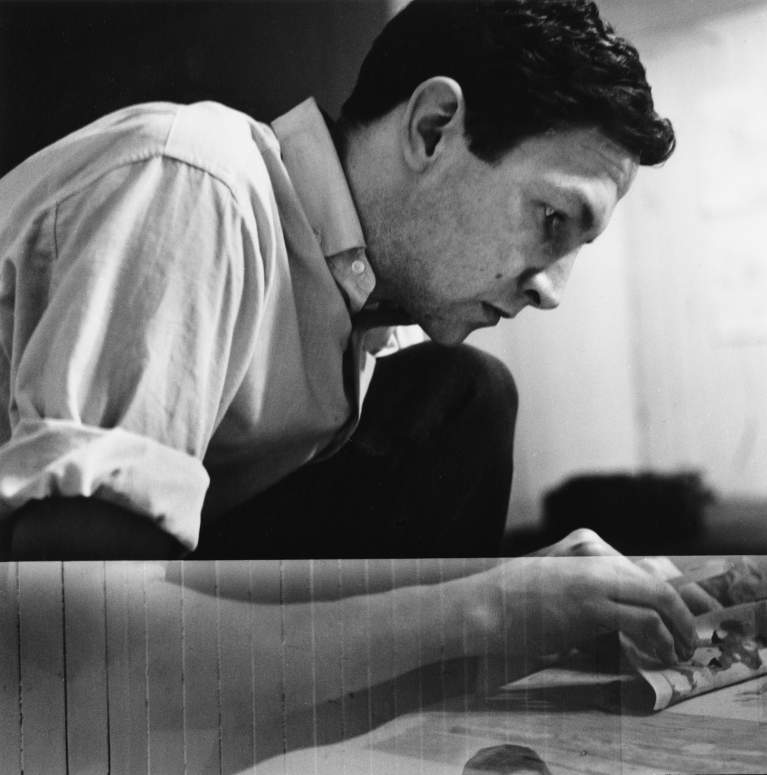 Rauschenberg working on a solvent transfer drawing in his Front Street studio, New York, 1958. Photo: Jasper Johns
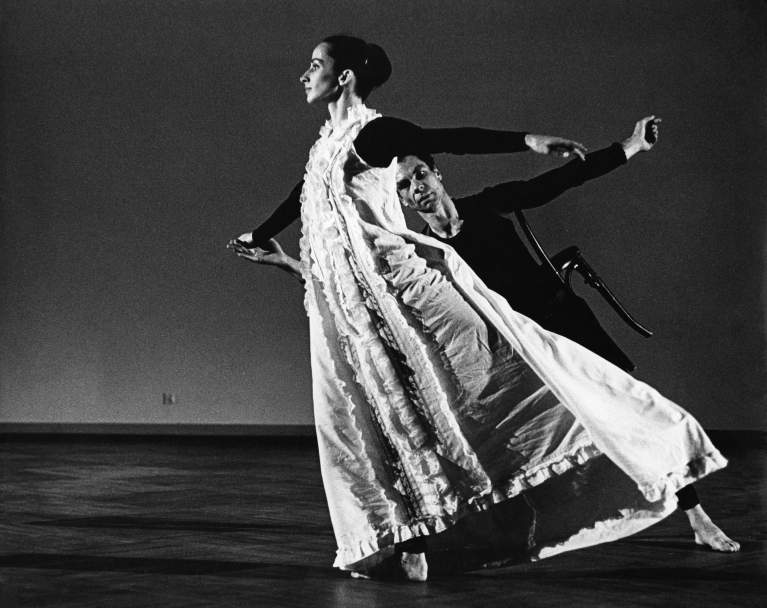 Costumes by Rauschenberg for Merce Cunningham Dance Company’s Antic Meet (1958), Five New York Evenings, Moderna Museet, Stockholm, September 1964. Pictured: Carolyn Brown and Merce Cunningham. Photo: Hans Malmberg
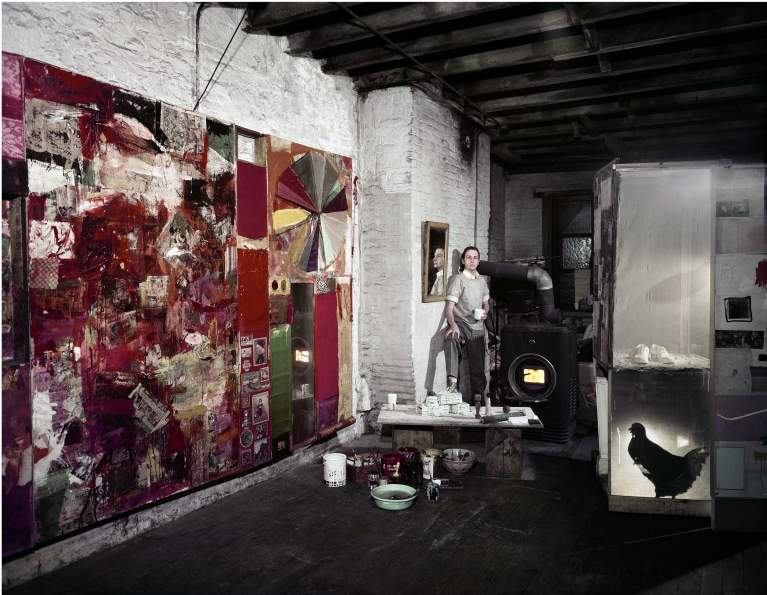 Rauschenberg in his Pearl Street studio, New York, March, 1958. Works shown are Charlene (1954), Untitled (ca. 1954), and partial rear view of the second state of Monogram (1955–59; second state 1956–58). Photo: Dan Budnik
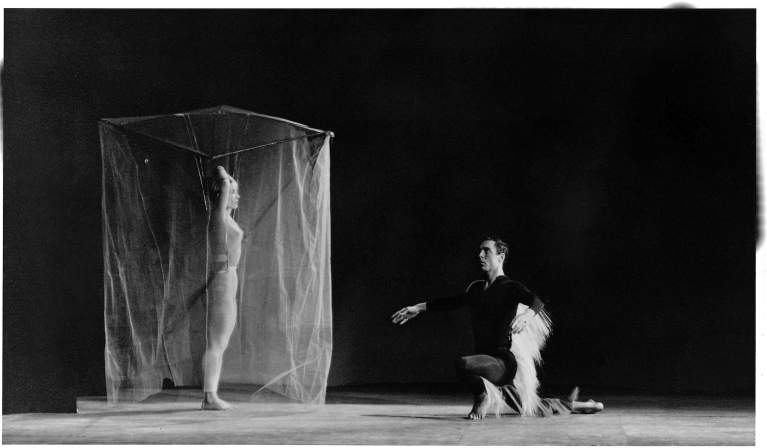 Set and costumes by Rauschenberg for Paul Taylor Dance Company’s Images and Reflections, 1958. Pictured: Maggie Newman and Taylor