

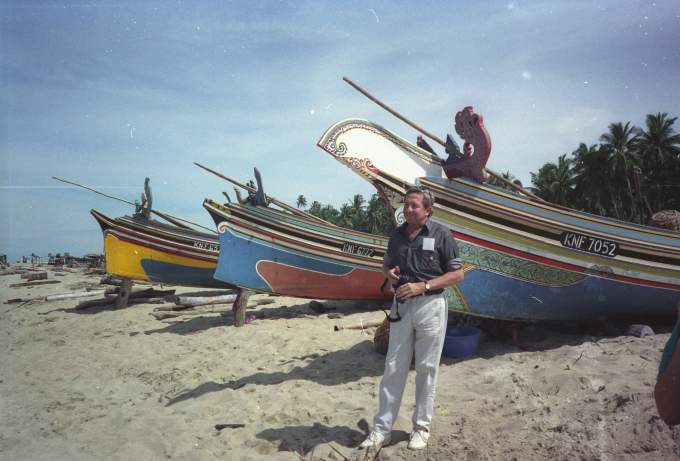
Robert Rauschenberg, Dasar Sabak beach, Kota Bharu, Malaysia, September 1989. Photo: Unattributed. Photograph Collection. Robert Rauschenberg Foundation Archives, New York.
ROCI Malaysia: Forests, Fabrics, and Friction
First announced at the United Nations in 1984, the Rauschenberg Overseas Culture Interchange (ROCI, pronounced “Rocky”) set out to use art as a means of cross‑border exchange during a volatile geopolitical moment. His conviction that art could be a catalyst for global dialogue played out vividly in Southeast Asia, where Rauschenberg brought his mix of photography, fabric, and found imagery into direct conversation with rapidly changing societies.
In honor of the exhibition Robert Rauschenberg and Asia opening on June 16, 2026 at ILHAM Gallery in Kuala Lumpur, Malaysia - organized by M+ in collaboration with ILHAM Gallery - this article revisits some of the artist’s time in Asia between 1964 and 1990.
"Art has no Borders" in a Changing Region
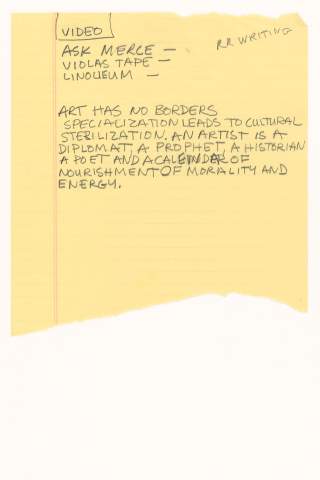
From early travels to Japan and India in the 1960s through to the late 1980s, Asia repeatedly offered Rauschenberg the opportunity to experiment with new materials and formats. Collaborations with papermakers, printers, and textile artisans across the region helped to shape his evolving thinking about how art could reflect an increasingly interconnected world.
According to print artist Donald Saff, the Creative Director for ROCI, the idea for the program emerged from one such encounter: during a 1982 visit to a paper mill in China, Rauschenberg was struck by how little local workers knew about events in neighboring counties, let alone in the West. That realization prompted him to imagine a traveling project that could “introduce” different cultures to one another through art, leading to a nearly decade‑long initiative that would touch ten countries and culminate in a major exhibition at the National Gallery of Art in Washington, DC, in 1991.
Mapping “Sensitive” Places
Conceived at the height of the Cold War, Rauschenberg focused deliberately on what he called “sensitive areas,” places where artistic freedom had been constrained and where contact with contemporary Western art was limited. With support from the National Gallery of Art and the United Nations, the project unfolded as a series of country‑specific exhibitions and residencies, funded largely by the artist, often in close partnership with local institutions, such as the Central House of Artists in the then-USSR or the Museo Nacional de Bellas Artes in Cuba.
Asia formed a crucial part of this map. Rauschenberg explored possibilities for ROCI projects in Sri Lanka and Thailand and realized full iterations in countries including China, Japan, and Malaysia. Each stop generated site‑responsive works that incorporated images, textures, and references drawn directly from the host country, building a cumulative portrait of late twentieth‑century global life that was anything but uniform.
On the Ground in Malaysia
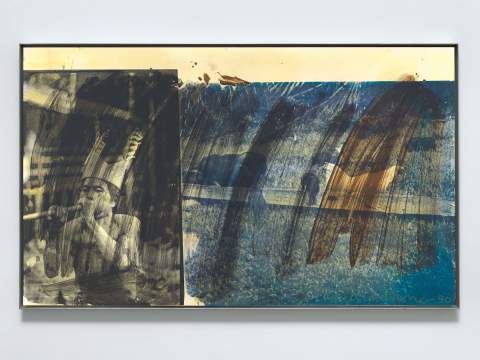
Rauschenberg’s engagement with Southeast Asia coalesced forcefully in Malaysia, where he visited in 1989 in preparation for the ROCI MALAYSIA exhibition at Balai Seni Lukis Negara, the National Art Gallery in Kuala Lumpur, in May 1990. At that time, the geopolitical map was shifting: the Cold War order was fracturing, and Southeast Asia was grappling with questions of modernization, resource extraction, and cultural identity.
Traveling between the capital and the state of Sarawak, he followed both ceremonial pageantry, such as the inauguration of the new king, and grassroots activism around environmental and indigenous rights. In Sarawak, on the island of Borneo, he encountered a “Save the Forest” campaign centered on the rapid destruction of rain forests and the impact on local hunters and indigenous communities. There, he purchased hundreds of T‑shirts and bamboo bracelets produced to support the movement, small objects that embodied a local struggle over land, labor, and resources and which would later feed into his thinking in the studio.
A Painting Series Between City and Jungle
The ROCI MALAYSIA (1990) painting series translated this fieldwork into a set of large‑scale works that combined patterned fabrics with silkscreened black‑and‑white photographs Rauschenberg took during his travels. Exhibited in Kuala Lumpur in May 1990, the works brought together images of ceremonial events, everyday street scenes, and glimpses of rural landscapes, anchored with textiles whose colors and motifs spoke to regional craft traditions, foregrounding “the conflict between urban and indigenous cultures within the country” and making that friction visible on the picture plane.
Fabric, Textiles, and the Texture of Place
Textiles had long been central to Rauschenberg’s work, from early costume designs to later series such as the Hoarfrosts (1974–76) and Jammers (1975–76). A recent exhibition at the Menil Collection in Houston, Texas, focused on the centrality of fabric in works by the artist from the 1970s. Travel repeatedly opened up exploration of new color palettes and material vocabularies and ROCI MALAYSIA participated in these experiments and explorations.
At Home, Abroad, and In‑Between
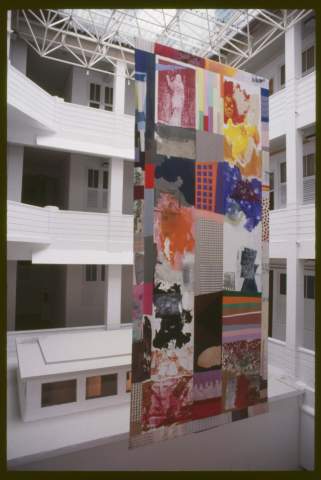
When the ROCI project finally came home to the National Gallery of Art in Washington in 1991, critics were quick to note both its audacity and its ambivalence, with Roberta Smith of The New York Times calling it “at once altruistic and self-aggrandizing.”
Yet the Malaysian chapter and Rauschenberg’s wider Asian engagements complicate any simple reading of the project as a one‑way export of Western art. In the forests of Sarawak, the streets of Kuala Lumpur, and the textiles that found their way into his studio, he was not only showing his work abroad; he was absorbing, and materially incorporating, the social, political, and environmental realities of the places he visited.
Robert Rauschenberg and Asia at ILHAM Gallery brings this history full circle. More than three decades after ROCI MALAYSIA opened at Balai Seni Lukis Negara as part of “Visit Malaysia Year 1990,” several of those works now return to Kuala Lumpur in the context of the artist’s centennial. The exhibition, which originated at M+ in Hong Kong, gathers over forty works made between 1975 and 1990, during and in response to Rauschenberg’s time in Asia. It traces how his travels across the region expanded his repertoire and how he, in turn, was received by the artists, artisans, and communities he encountered.
Presented in partnership with M+ and supported by the Robert Rauschenberg Foundation, the show invites Malaysian audiences to reconsider Rauschenberg as a key figure in the global history of contemporary art, and as an artist whose experiments with assemblage, textiles, photography, and installation were profoundly shaped by Asia.
At a moment when the interconnected world he championed is strained by resurgent nationalisms, Robert Rauschenberg and Asia asks what it might mean to revisit his commitment to cross‑cultural exchange from the vantage point of Kuala Lumpur today, and how the conversations he began through ROCI might continue to evolve in the region’s museums, studios, and communities.