
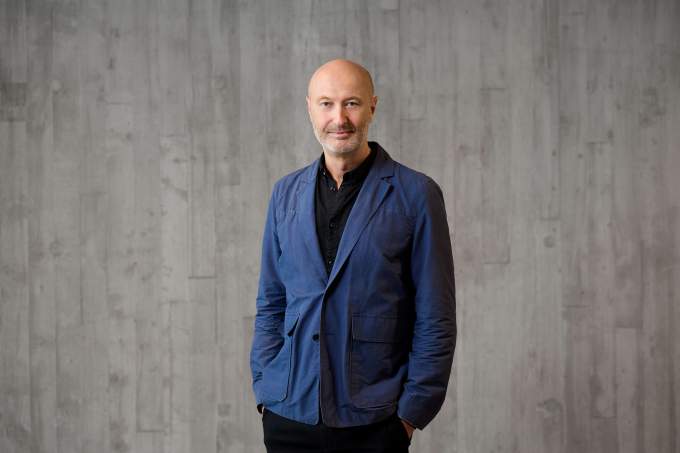
Russell Storer, Senior Curator and Associate Director of Curatorial Affairs, M+, and curator of Robert Rauschenberg and Asia. Image courtesy of M+ Hong Kong.
Process & Possibility: Three Questions With Russell Storer
When Robert Rauschenberg embarked on his far‑reaching projects across Asia in the 1980s as part of the Rauschenberg Overseas Culture Interchange (ROCI) project, he sought to expand the possibilities of artistic exchange: collaborating with local artisans, experimenting with new materials, and reimagining how art could move across cultures. Decades later, Rauschenberg in Asia, an exhibition at M+ in Hong Kong, revisits these groundbreaking encounters and their lasting impact on artists throughout the region.
For Russell Storer, Senior Curator and Associate Director of Curatorial Affairs at M+, “working on this exhibition has been a revelation” in appreciating the breadth of Rauschenberg’s engagements across Asia and “his extraordinary commitment to making a difference in the world with an optimistic vision to connect people, cultures, disciplines, and technologies through his work.” Storer recalls first encountering Rauschenberg’s cardboard and metal works as an art history student in Sydney, Australia, drawn to their “raw materiality and ‘making‑do’ quality.” Over time, he came to see “the great precision in how Rauschenberg deployed these materials, his mastery of composition, and his constant, fearless search to incorporate new techniques and media.”
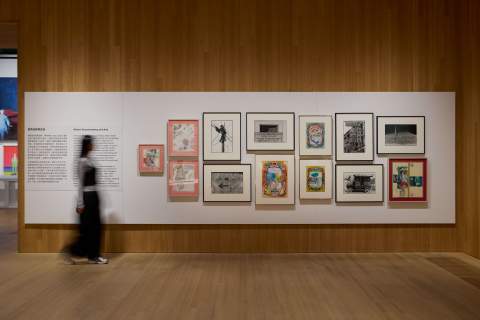
That same curiosity and generosity are at the heart of the exhibition, which brings together rarely seen works alongside archival materials and new perspectives, tracing Rauschenberg’s journeys through India, China, Japan, and beyond, revealing how his curiosity and generosity reshaped both his own practice and the landscape of global contemporary art.
To explore how the exhibition reflects Rauschenberg’s boundary‑defying vision and why his spirit of experimentation continues to inspire curatorial practice today, we asked Russell a few questions.
Rauschenberg often blurred boundaries between disciplines and materials. How has that spirit of experimentation influenced your approach to curating at M+?
Responding to this aspect of Robert Rauschenberg’s work was to me one of the most exciting aspects of curating this exhibition. A transdisciplinary approach is somewhat taken for granted in contemporary art now, but Rauschenberg was so fundamental to the breaking down of these boundaries. His influence still resonates so powerfully today across generations and borders. It was important for our visitors to see this, so we included works and video interviews of Asian artists who came into contact with his works and responded to it, or worked in similar ways.
Rauschenberg’s incredible energy and voracious curiosity, where he seemed to have no fences or brakes, is what really struck me as we researched this exhibition. We tried to capture his generous, expansive spirit in the show by looking at the many varied ways that he worked across the region. As the exhibition tracks his Asian projects across time and geography, it touches on many different media, from photography, paper works and textiles to assemblage and ceramics. His experiments working with paper mills in India and China are so strange, complex and beautiful, and are the works to which people have responded most strongly. It shows how you can take a very traditional technique and simple material, push the limits of what can be done, and make something entirely new, while retaining the spirit of the context in which they were made.
M+ positions itself as a museum of visual culture rooted in Hong Kong but connected to the world. How do you navigate that balance in your curatorial work?
M+ is a unique museum in Asia, as its collection and program traverses visual art, moving image, and architecture and design, enabling us to explore rich connections across disciplines and between cultures, both within Asia and globally. This transnational and transdisciplinary approach has long been an interest for me as a curator. I began working in art museums in Australia, a multicultural country with a deep First Nations history, and then in Singapore, which is also very multicultural, with both actively debating their changing national identities. They are both also far from established art world centres, so thinking relationally about art, and looking at the world from these very specific places and perspectives is very important. You can’t take the conventional Euro-American narratives of art as a given, and you need to think critically about where you are speaking from and who you are speaking to. I was particularly interested in how Australia relates to its neighbours, developing exhibitions with Asian and Asian-Australian artists, and working on the Asia Pacific Triennial in Brisbane, which is a foundational project in rethinking the histories and presentation of contemporary art in the region since the early 1990s.
The curatorial vision at M+ is very strong, grounded in Hong Kong and greater China but always looking at artistic and cultural connections to the region and beyond, in both directions. It was exciting to think about Rauschenberg from this perspective: a towering figure in global contemporary art, but usually in terms of his great innovations in New York in the 1950s and 1960s and what flowed out from that. To look at his later projects in Asia, and their profound legacy for Asian artists as well as how they impacted his own practice, offered a new angle on his significance, which was not contingent on the US but realigned him elsewhere. These are the contributions that M+ can make as a Hong Kong museum that can’t be done elsewhere!
What’s a recent exhibition or artist at M+ that, to you, embodies the same curiosity and boundary‑pushing energy that Rauschenberg championed?
While you can see resonances with Rauschenberg across our collection and program, M+ recently presented the first retrospective of the Chinese-American architect I.M. Pei (I.M. Pei: Life is Architecture, 29 Jun 2024 - 5 Jan 2025), who shared Rauschenberg’s open and curious spirit and boundary-busting energy. They were of a similar generation (Pei was born in 1917, Rauschenberg in 1925), and both had the ambition to make a difference in society through their work. Both consistently explored new materials and technologies and regularly collaborated with other artists and artisans, and they shared an inclusive, transcultural vision that integrated local and traditional forms, materials, and techniques into their groundbreaking works. Pei and Rauschenberg were extraordinary connectors and negotiators, each working within very diverse contexts globally, often in quite challenging circumstances. Their clear vision, creative adaptability, and personal charm enabled incredible things to happen, with profound effects that are still being felt around the world.