
1970-79
1972
First Landing Jump (1961) acquired by the Museum of Modern Art, New York, as a gift from Philip Johnson, who had purchased the work in 1964 at the encouragement of the museum’s director, Alfred H. Barr Jr.
Emile de Antonio’s film Painters Painting, which includes an interview with Rauschenberg, is released. The film is based on the exhibition New York Painting and Sculpture, 1940–1970, organized by Henry Geldzahler, Metropolitan Museum of Art, New York (October 18, 1969–February 8, 1970).
Introduced by U.S. Senator Jacob Javits (R-N.Y.) to Israeli Foreign Minister Abba Eban. Through Eban, Rauschenberg meets Prince Sadruddin Aga Khan of Egypt and becomes interested in creating a work, never realized, relating to the Arab-Israeli conflict.
January: Establishes working relationship with Graphicstudio, USF Institute for Research in Art, Tampa, which is under the direction of Donald Saff, who founded the studio in 1968 as a center for print research and collaboration with the university’s departments of chemistry, engineering, and architecture.
January–March: At Graphicstudio, working with Saff, makes Made in Tampa series (1972–73), twelve works published in editions of forty, incorporating lithography, blueprint, and sepia print, as well as elements of collage. Makes Tampa Clay Piece series(1972–73), five clay works published in an edition of twenty, at the suggestion of Graphicstudio sculptor Alan Eaker, who proposed that Rauschenberg turn cardboard boxes into ceramic pieces, just as he had previously created Cardbirds (1971) from cardboard prototypes. For the Tampa Clay Pieces, the printers mix garden soil with the clay, then apply oil from their own faces to the fired surface to replicate the color and texture of cardboard.
April 25: Receives Skowhegan Medal for Graphics, Skowhegan School of Painting and Sculpture, Maine, at the Plaza Hotel, New York. Jasper Johns receives the Medal for Painting and Claes Oldenburg the Medal for Sculpture.
May: Exhibits Cardboards, Galerie Ileana Sonnabend, Paris.
Under the sponsorship of Universal Limited Art Editions (ULAE), West Islip, New York, begins collaboration with novelist, philosopher, and screenwriter Alain Robbe-Grillet on a book, Traces suspectes en surface (1978), published in an edition of thirty-six. Tatyana Grosman, aware of Rauschenberg’s interest in working on a handmade book, pairs the artist and the author after hearing Robbe-Grillet express admiration for Rauschenberg in a lecture at New York University in April. Robbe-Grillet and Rauschenberg agree that Rauschenberg will loosely respond to the text of the novel, which deals with romance and murder, rather than diligently illustrate it. Robbe-Grillet will send Rauschenberg the first three pages of text inscribed on aluminum plates in the fall of 1972. Rauschenberg will respond with three pages of lithographs made using a solvent-transfer technique with images of everyday life from European publications to complement the text and suggest new ideas to Robbe-Grillet. By 1974, after about twelve exchanges, all of the text and images will be completed. Printing will begin in 1976. The book will be published in 1978. Rauschenberg will create a simple red clothbound box for the prints.
Late June: Begins Venetian series, the majority of which is made in 1973. These sculptural works, inspired by his many visits to Venice, are made of nontraditional art materials, including branches, tire treads, and glass jars, with an emphasis on the natural shapes of the found objects.
September 18: Travels to California and while there begins work on Horsefeathers Thirteen (1972–73) published by Gemini G.E.L., Los Angeles. The series consists of lithographs with collage and embossing, each print containing both fixed and variable images.
October 27: Party held in honor of Princess Christina of Sweden, Rauschenberg’s Lafayette Street studio, New York, raises funds for the New York Collection for Stockholm, a collection of works by American artists selected by Pontus Hultén and organized by Experiments in Art and Technology (E.A.T.), New York, between 1971 and 1973, for donation to Moderna Museet, Stockholm. Three hundred people attend the event. At Rauschenberg’s request, Teledyne, Los Angeles, will donate Mud Muse (1968–71) to the collection. A preview of the artworks is presented at Leo Castelli, Sonnabend, and John Weber Galleries, 420 West Broadway, New York (October 27–28). Rauschenberg, however, does not exhibit Mud Muse and instead shows Volon (Cardboard) (1971).
December 2–24: Exhibits Tampa Clay Pieces (1972–73), Leo Castelli, New York, and Made in Tampa (1972–73), Castelli Graphics, New York.

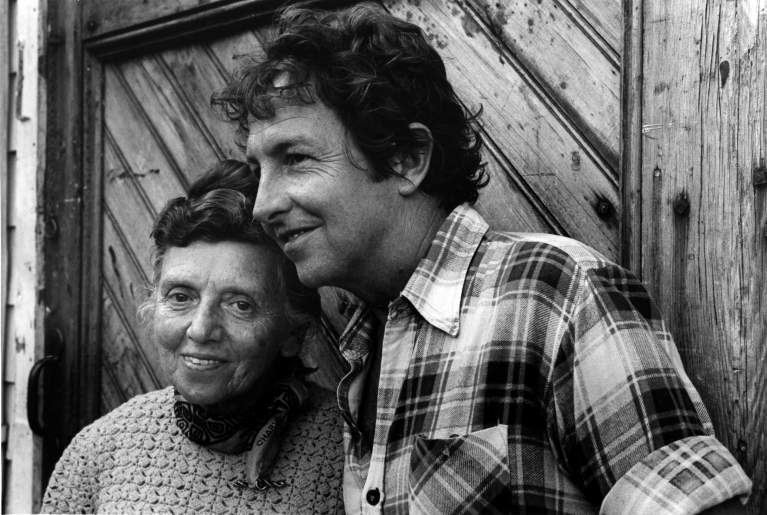 Rauschenberg and Tatyana Grosman, 1972