
Rauschenberg Foundation Announces Major Archives Initiative
Beginning January 1, 2027, the Robert Rauschenberg Foundation Archives will close to researchers for an estimated eighteen months as the Foundation undertakes a major initiative to expand its access to physical materials and digitize its archival collections.
Over the past five years, we have seen significant growth in both the number and scope of research inquiries related to Robert Rauschenberg. This interest expanded further during the Centennial, with scholars increasingly examining not only Rauschenberg’s artistic practice, but also his political engagement, philanthropy, travels, collaborations, and the broader cultural networks that informed his life and work. As a result, the Foundation is making a significant investment in the accessibility, digitization, and preservation of archival materials that support these increasingly expansive areas of research. This temporary closure will allow the Archives team to focus its resources on this work.
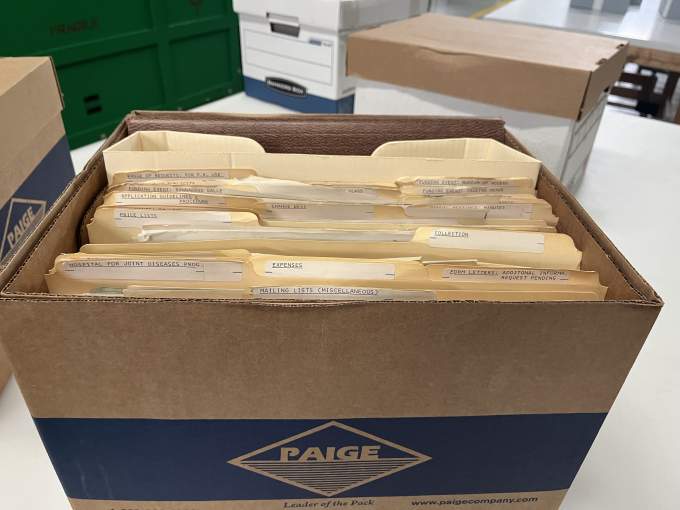
Among the collections that will be a focus of this initiative are the records of Change, Inc., Rauschenberg’s first formal foray into philanthropy. Established in 1970 to provide emergency financial assistance to professional visual artists, Change, Inc. has a history spanning more than fifty years and has awarded thousands of grants to artists. Currently, these records are unavailable to research; once open, the archival records offer an important resource for understanding Rauschenberg’s longstanding commitment to artists and the role of philanthropy within his broader practice as well as providing access to nearly 2,500 non-confidential artist grantee files, including resumes, statements, newspaper clippings, flyers, and correspondence (often handwritten).
The project will also encompass Rauschenberg’s “Treasures” collection, approximately fifty boxes of objects and artifacts Rauschenberg gathered during his extensive travels from the 1950s through the 2000s. These materials provide another lens through which to consider the places, people, cultures, and visual sources that shaped his thinking and work.
Additional resources to be catalogued and digitized include a newly created poster reference library, which provides access to posters designed by Rauschenberg. The collection provides a rich record of an important aspect of his graphic practice.
Simultaneously, the archives will embark on a mass digitization initiative, broadening remote access to archival materials. Target collections include documentary photographs, correspondence, museum and gallery records, and project files.
The project will also provide enhanced access to new resources created from research initiatives. The Foundation has launched a performance research initiative to focus on Rauschenberg's performance output and his extensive engagement with that community.
The above work reflects a broader priority of the Robert Rauschenberg Foundation: to ensure that the myriad records surrounding Rauschenberg’s life, work, and legacy are preserved and made increasingly accessible to scholars, artists, students, and the public. As research on Rauschenberg continues to evolve, the Foundation recognizes the importance of facilitating access to collections that illuminate less-studied dimensions of his practice and the remarkable range of his interests and activities.
The Archives will be closed to researchers beginning January 1, 2027, with research access expected to resume in late 2028.
Those interested in booking research appointments before the end of this year are encouraged to do so as soon as possible by contacting archives@rauschenbergfoundation.org.
Additional information about the digitization initiative, newly accessible collections, and the reopening of the Archives will be shared as the project progresses.