
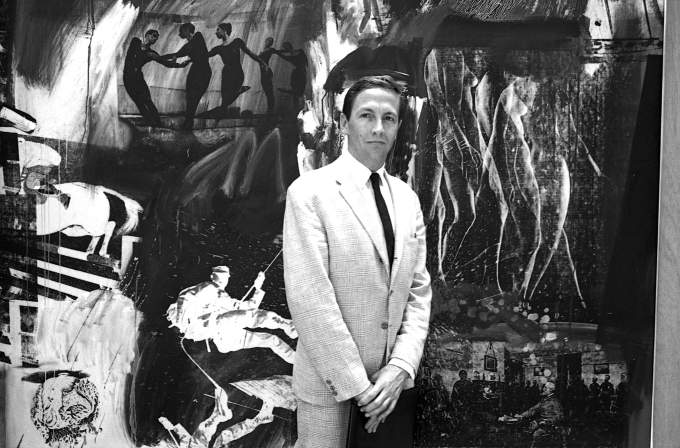
Robert Rauschenberg in front of his silkscreen painting Express (1963) at the XXII International Biennale of Art Exhibition, Venice, 1964. Photo: Ugo Mulas © Ugo Mulas Heirs. All rights reserved.
Rauschenberg Legacy Echoes in Venice
The Rauschenberg Foundation congratulates alumni/ae of our Captiva Residency program participating in the 61st Venice Biennale. This year's exhibition, entitled In Minor Keys and curated by Koyo Kouoh, focuses on "small, impactful, and intimate moments, inspired by the melancholic yet profound nature of minor key music."
Known as the “Olympics of the art world” and held in Venice since 1895, the Biennale is one of the most prestigious platforms for contemporary art, uniting artists, curators, and national pavilions from across the world.
Rauschenberg earned international acclaim at the Biennale in 1964, winning the Grand Prize for Painting–the first American artist to do so (as depicted in the 2023 film Taking Venice). More than sixty years later, his spirit of experimentation and interest in cross-cultural dialogue still resonates in Venice through the work of artists who have spent time in Captiva, a place central to his creative risk-taking and interdisciplinary exploration.
We are proud to highlight nine of our alumni/ae today:
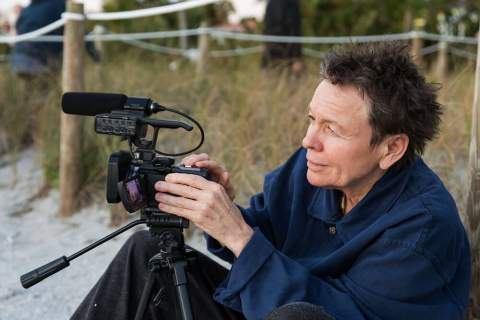
Laurie Anderson (Residency 10, 2015)
@laurieandersonofficial
Laurie Anderson, who studied art history at Barnard College and received an MFA in sculpture from Columbia University, lives and works in New York. A pioneering figure in performance and media art, her interdisciplinary practice spans music, film, virtual reality, writing, and installation, using storytelling and emerging technologies to examine language, memory, politics, and perception. Anderson rose to prominence with O Superman (1981) and has since presented major projects at institutions including the Hirshhorn Museum, MASS MoCA, and the Armory. During her 2015 residency with the Robert Rauschenberg Foundation on Captiva, she completed the score for her film Heart of a Dog, describing the uninterrupted time there as transformative: “Probably for me, the most valuable part of that experience was being able to get uninterrupted time so that I could just get up and not have to make phone calls and not have to figure out how to get from here to there or have this or that meeting. Meetings were all canceled. They were all canceled. I actually did retool my work ethic in that time.”
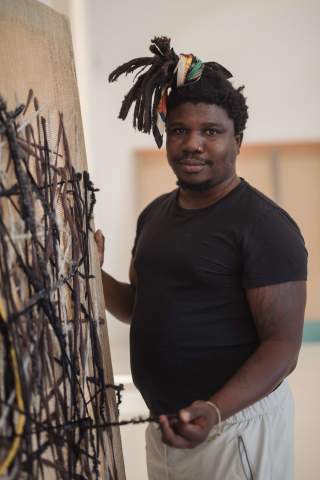
Alvaro Barrington (Residency 35, 2018)
@alvarobarrington
Alvaro Barrington, born in Caracas, Venezuela, is a multidisciplinary London-based artist with an MFA from Slade School of Art and a BFA from Hunter College. The artist, a self-proclaimed “big fan” of Rauschenberg, harnesses abstract painting, embroidery, sculpture, and site-specific installations to explore communal histories, migration, and cultural exchange, drawing from motifs like hibiscus, Marcus Garvey, and hip hop legacies, on materials such as burlap, concrete, chain, and metal gates. He draws crucial influence from Rauschenberg’s groundbreaking approach to material, collaboration, and cross-cultural references, calling the time he spent with the Robert Rauschenberg Foundation one that left him “forever changed.”
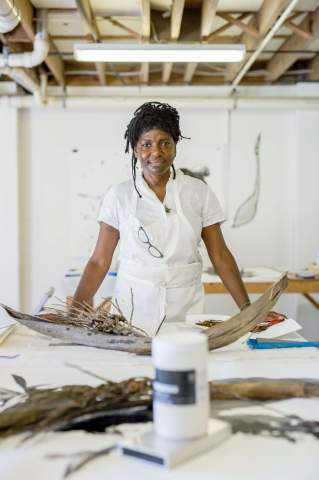
Magdalena Campos-Pons (Residency 21, 2016)
@maria_magdalena_campos_pons
Magdalena Campos-Pons, who studied at the Escuela Nacional de Arte in Havana and later at the Instituto Superior de Arte, lives and works in Nashville. Her multidisciplinary practice spans photography, installation, performance, and video, exploring themes of migration, memory, gender, and Afro-Cuban identity, often rooted in her family history and the legacies of the transatlantic slave trade. Known for richly symbolic, large-scale photographic works and immersive installations, she has exhibited widely, including at the Museum of Modern Art, the National Museum of African Art, and the Havana Biennial. Her work will be featured at the Obama Presidential Center in Chicago when it opens to the public in June 2026.
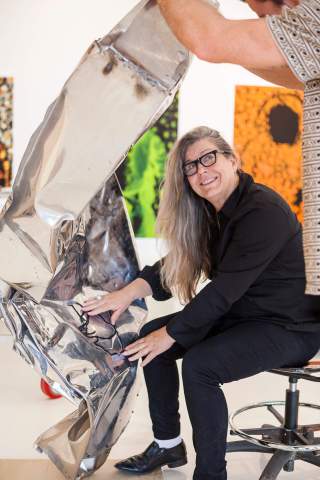
Dawn DeDeaux (Residency 2, 2013)
@dawndedeaux
Dawn DeDeaux studied at Newcomb College of Tulane University and lives and works in New Orleans. Working across sculpture, installation, photography, and time-based media, her practice confronts environmental crisis, consumer culture, and the fragility of human systems, often through immersive, large-scale environments that blur satire and catastrophe. Her long-running MotherShip project, initiated in the 1980s, envisions escape and survival in the face of ecological collapse, positioning her as a prescient voice on climate anxiety. Major presentations include exhibitions at the New Orleans Museum of Art and the Ogden Museum of Southern Art, as well as inclusion in Prospect triennials.
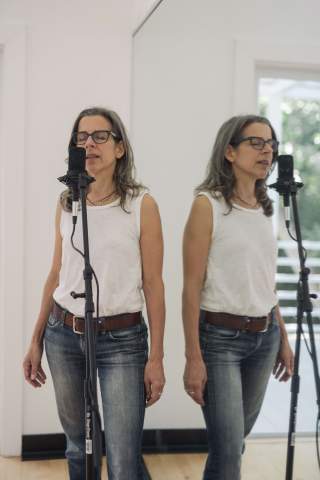
Nina Katchadourian (Residency 35, 2018)
@NinaKatchadourian
Reflecting on “the spirit of Bob,” Nina Katchadourian encourages people “to meet and see what happens when they put their heads together.” This Stanford-raised, Brooklyn- and Berlin-based interdisciplinary artist, holding a BFA from Brown University and MFA from UC Berkeley, works across video, performance, sound, sculpture, photography, and public projects, often transforming mundane materials and self-imposed constraints into playful conceptual inquiries about language, history, family, and the overlooked. Known for works like Accent Elimination (included in the 2015 Venice Biennale’s Armenian pavilion, which won the Golden Lion) and site-specific commissions such as MoMA’s Dust Gathering audio tour, her practice thrives on collaboration and surprise, drawing upon Rauschenberg’s ethos of open exchange and experimentation.
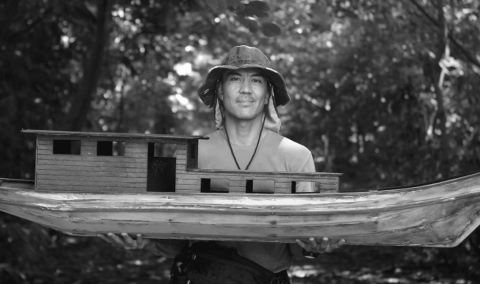
Tuan Andrew Nguyen (invited to Residency 53, 2026)
@tuan.andrew.nguyen
Nguyen was born in Vietnam and currently resides in Ho Chih Minh City. He and his family emigrated as refugees to the United States in 1979, and he grew up in Oklahoma and Southern California. He earned a BFA from the University of California, Irvine and an MFA under Daniel Joseph Martinez at California Institute of the Arts. Nguyen’s work, based on extensive research and community engagement, explores the power of storytelling through video and sculpture. He is a cofounding member of the artist collective The Propeller Group. In a forthcoming commission for The High Line in New York City, slated for 2026-2027, a work titled The Light That Shines Through the Universe will recreate the 6th-century Bamiyan Buddhas of central Afghanistan, a UNESCO World Heritage Site notably destroyed in 2001. Nguyen was named a MacArthur Fellow in 2025, and his work is included in the collections of The Museum of Modern Art, The Solomon R. Guggenheim Museum, the San Francisco Museum of Modern Art, among others.
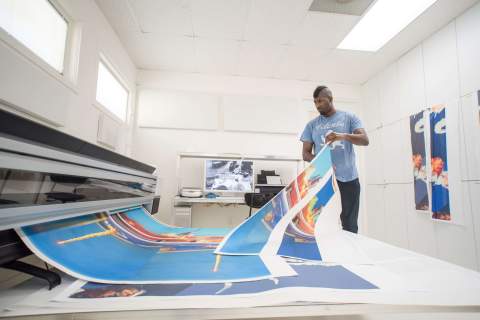
Kambui Olujimi (Residency 24, 2017)
@KambuiOlujimi
Kambui Olujimi was born and raised in Bedford-Stuyvesant, Brooklyn, and holds an MFA from Columbia University. As an interdisciplinary artist, his practice includes various media and embraces collaboration, much like Rauschenberg’s boundary-crossing practice. His solo exhibitions include Zulu Time at Madison Museum of Contemporary Art and A Life in Pictures at MIT List Visual Arts Center; his works have premiered at Sundance, Studio Museum in Harlem, MoMA, MOCA Los Angeles, and internationally at Museo Nacional Reina Sofía and more. Echoing Rauschenberg’s fascination with space and involvement with NASA, Olujimi’s T Minus Zero, North Star, and Skywriters explore themes of space, memory, and mythology.
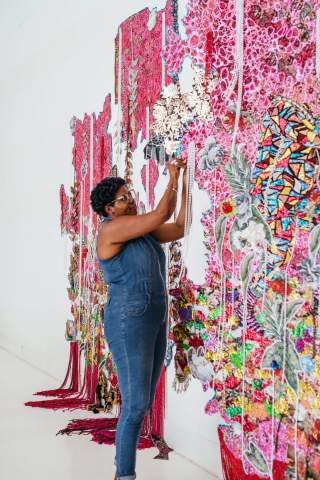
Ebony G. Patterson (Residency 26, 2017)
Ebony G. Patterson, who earned her BFA from Edna Manley College and MFA from Washington University in St. Louis, lives and works between Kingston and Chicago. With a painterly sensibility, her expansive practice across tapestry, photography, video, sculpture, drawing, and installation addresses visibility and invisibility amid class, race, gender, youth culture, violence, and "postcolonial" spaces, elevating the marginalized through intricate, embellished layers that trap viewers with beauty to confront social injustice. Major solo exhibitions include the touring …while the dew is still on the roses… (Pérez Art Museum Miami, 2018 onward) and Dead Treez (Kohler Arts Center, 2015), with accolades including the 2024 MacArthur Fellowship, United States Artists Award. Spending time with the Robert Rauschenberg Foundation in 2017, Patterson developed work on “witnessing,” photography, and self-image, reflecting on Rauschenberg’s legacy as a “spiritual” experience.
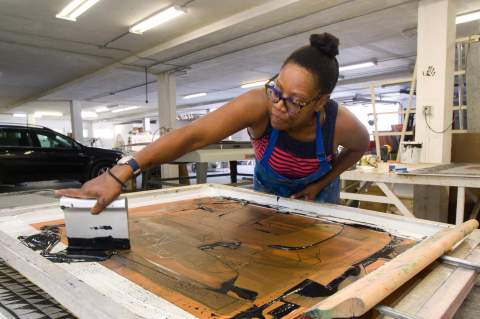
Cauleen Smith (Residency 15, 2015)
@cauleen_smith
Cauleen Smith, who earned her BA in Creative Arts from San Francisco State University and MFA from UCLA, lives and works in Los Angeles. Working across film, installation, sculpture, and textiles, her practice draws on Afrofuturism, experimental cinema, and Black cultural histories to explore space, spirituality, and collective memory. Her films and installations often center Black subjectivity as a site of resilience and imagination, weaving together references that range from Sun Ra to Alice Coltrane. Smith’s work has been featured in major exhibitions at the Whitney Museum of American Art, the Los Angeles County Museum of Art, and in the 2017 Whitney Biennial.
In addition to the alumni/ae whose work will be exhibited, curator and writer Adrienne Edwards (Residency 26, 2017) is a key supporter of and contributor to The Poetry Caravan, a poetic procession to take place during the exhibition’s opening days, and visual artist Park McArthur (Residency 29, 2018) contributed a text for the exhibition catalogue. Their involvement further underscores the Biennale’s ongoing engagement with leading voices shaping contemporary art discourse.
As the international art community gathers once again in Venice, the presence of these alumni/ae offers a powerful reminder that Rauschenberg’s legacy is not fixed in the past, but actively carried forward through the work of artists shaping the present. Their contributions to this year’s Biennale reflect a legacy rooted in generosity, curiosity, and an unwavering belief in the transformative power of art. We hope you visit their work if you find yourself in Venice this summer.