A BRIEF OVERVIEW
A native of Port Arthur, Texas, Robert Rauschenberg was born on October 22, 1925. After briefly attending the University of Texas at Austin to study pharmacology, and serving in the United States Navy during World War II, he enrolled at the Kansas City Art Institute in 1947. In early 1948, he traveled to Paris to study at the Académie Julien, where he met fellow artist Susan Weil; they later married and had a son, Christopher. In the autumn, the couple returned to the United States to study under Josef Albers at Black Mountain College near Asheville, North Carolina until the spring of 1949. Later that year, Rauschenberg moved to New York City and enrolled at the Art Students League. Rauschenberg returned to Black Mountain College in 1951 and again in 1952 when he formed friendships with Merce Cunningham, John Cage, and David Tudor, and participated in CageʼsTheater Piece #1, which is now acknowledged as the first Happening. Since the early 50s, Rauschenbergʼs sustained involvement in theatre and dance has resulted in costume and set designs for Merce Cunningham, Paul Taylor, Viola Farber, Steve Paxton, and Trisha Brown, as well as for his own productions.
Robert Rauschenberg and Model with "Blueprint," 1951.
Photo by Wallace Kirkland for Life Magazine © Getty Images. All rights reserved.
A BRIEF OVERVIEW
Rauschenbergʼs first solo exhibition was held at the Betty Parsons Gallery, New York in Spring 1951 where he showed paintings that incorporated elements such as maps and mirrors. His next body of work, the uninflectedWhite Paintings (1951), became screens for light and shadow as they responded to the conditions around them. From the autumn of 1952 to the spring of 1953, Rauschenberg traveled to Europe and North Africa with Cy Twombly whom he met at the Art Students League. During his travels, Rauschenberg worked on a series of small collages, hanging assemblages, and small boxes filled with found elements that were exhibited in Rome and Florence. Upon his return to New York in 1953, he began work on the Red Paintings to which he added newspaper and patterned fabric. It was towards the end of this year that Rauschenberg first met Jasper Johns. By the summer of 1954, Rauschenberg introduced found objects into the Red Paintings, creating his first Combines; works that pushed the boundaries of what an artwork could be. This interplay of different media has remained central to Rauschenbergʼs work, which has been marked throughout his career by a sense of experiment and play.
Robert Rauschenberg with an early Combine, "Untitled," ca. 1954.
Photo by Ed Wergeles © Ed Wergeles. All rights reserved.
A BRIEF OVERVIEW
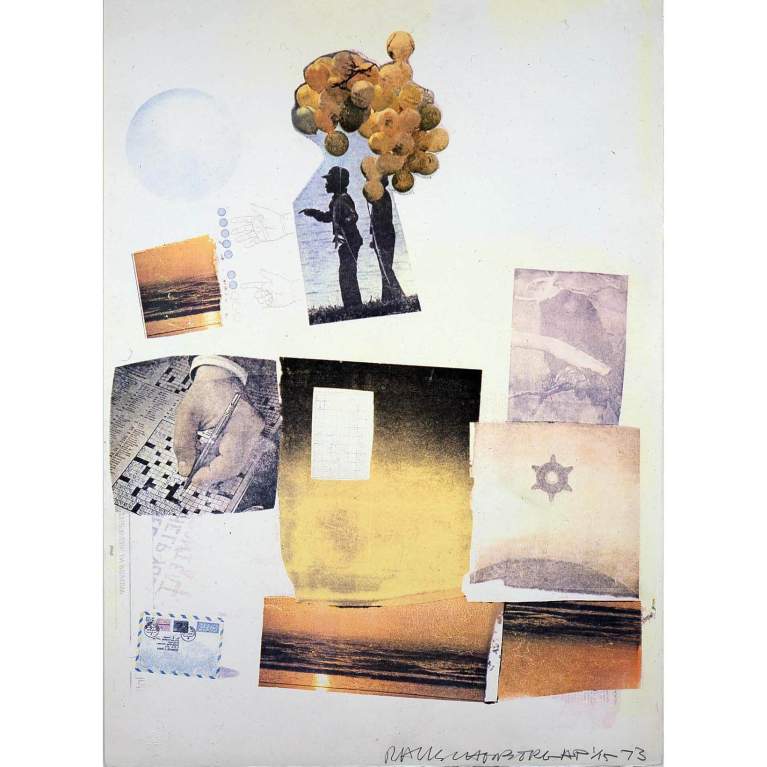
By the late 1950s and early 1960s, the found image became paramount in Rauschenbergʼs visual vocabulary. Reproductions from newspapers and magazines were incorporated into his drawings, prints, and paintings as he perfected techniques of solvent-transfer, lithography, and silkscreening. The transfer drawings, produced simultaneously with the laterCombines, brought the element of collage onto a two-dimensional plane; found images were now continuous with the picture surface and were mixed with freely drawn and painted areas. This admixture of figuration and abstraction remained a hallmark of Rauschenbergʼs style throughout his career.
A BRIEF OVERVIEW
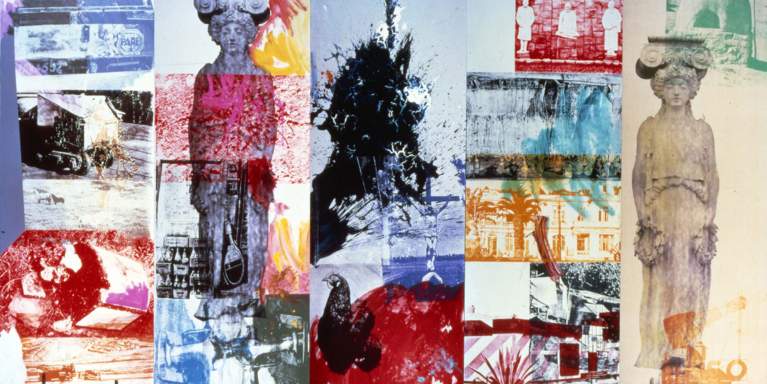
The silkscreened painting series, made between 1962 and 1964, used a commercial means of reproduction and emphasized media subjects, identifying Rauschenberg with Pop Art. The photomechanically produced screens allowed him to transcribe his own photographs as well as images taken from the popular press on a large scale. Rauschenbergʼs experiments with the use of electronics in his art led to the establishment in 1966 of Experiments in Art and Technology (E.A.T.) with Bell Telephone Laboratories engineer Billy Klüver, which promoted cooperation between artists and engineers. His five-part construction,Oracle (1960–65) and the mirrored wall Soundings (1968) whose lights are activated by viewerʼs sounds were realized from this collaboration. Rauschenbergʼs lifelong quest for new materials, new technologies, and new ideas has led him to continuously explore new and often untraditional avenues.
A BRIEF OVERVIEW
With his move in 1970 from New York to Captiva, an island off the Gulf Coast of Florida, Rauschenberg cleared his palette. Retreating from urban imagery, he now favored an abstract idiom and the use of natural fibers, such as fabric and paper. TheCardboards (1971) and Venetians (1972–73) reveal his fascination with the inherent color, texture, and history of found materials. The beautiful and disparate effects of fabrics, ranging from cotton to satin, are explored in the Hoarfrosts (1974–75) and Jammers (1975–76). His Spreads (1975– 82) and Scales (1977–81) incorporate transferred and screened images and assemblage, sometimes in room- scale installations.
A BRIEF OVERVIEW
In 1984, The Rauschenberg Overseas Culture Interchange (ROCI) was established. An evolving exhibition of over 200 works, the project was a tangible expression of his belief in the power of art and artistic collaboration to bring about social change on an international level and the culmination of his long-term commitment to human rights. The eight-year tour explored diverse cultures and local art-making practices in Mexico, Chile, Venezuela, China, Tibet, Japan, Cuba, Russia, Germany, Malaysia, and a final exhibition held at the National Gallery of Art, Washington, D.C. Rauschenbergʼs lifelong commitment to collaboration— performers, printmakers, engineers, writers, artists, and artisans from around the world—is a manifestation of his expansive artistic philosophy
A BRIEF OVERVIEW
Having first painted and screened on copper for ROCI Chile in 1985, over the next decade, Rauschenberg explored the use of metal as a support for paint, tarnishes, enamel, and screen-printed images in several subsequent series. Imagery and found objects often referred to Rauschenbergʼs travels, while reflective metallic surfaces mirrored the immediate surroundings of the works. The metal paintings have a wide range of effects, from the brilliantly colored enamels of theUrban Bourbons (1988–95) to the dark monochrome of the Night Shades (1991). The Gluts, begun in 1986, are made from scrap-metal objects, such as gas station signs and automobile parts that often mask their original identities when transformed into wall and freestanding sculptures.
A BRIEF OVERVIEW
Beginning in 1992, Rauschenberg used an Iris printer to make digital color prints of his photographs, resulting in the high-resolution images and luminous hues in the large-scale works, theAnagrams (1995–2000), Short Stories (2000–2003), Scenarios (2002–2006), and the Runts (2007–2008). Utilizing pigment transfer technique, these series incorporate his early vision with the latest advances in technology. The theme of inclusion, both in the choice of materials used and in the relationship between the art and the viewer, has always permeated Rauschenbergʼs art. Whatever media he has chosen, whether paint on canvas, metal, Plexiglas, paper, fresco, cardboard or fabric, he has always been a forerunner in almost every aspect of contemporary art.
Robert Rauschenberg lived and worked on Captiva Island, Florida from 1970 until his death on May 12, 2008.