BIOGRAPHY
Robert Rauschenberg (1925–2008)
Robert Rauschenberg was the defining force in contemporary art for nearly sixty years, creating a wealth of art (painting, photography, sculpture, performance, and printmaking) more varied than that of any artist of the twentieth or twenty-first centuries. For him, painting entailed not only using a brush, but also silkscreening, collaging, transferring, and imprinting, and he did so on the widest array of materials from canvas, board, and fabric to sheet metal, Plexiglas, plaster, and paper. He has been called a forerunner of virtually every postwar American art movement since Abstract Expressionism, however, he remained fiercely independent from any particular affiliation throughout his protean life.
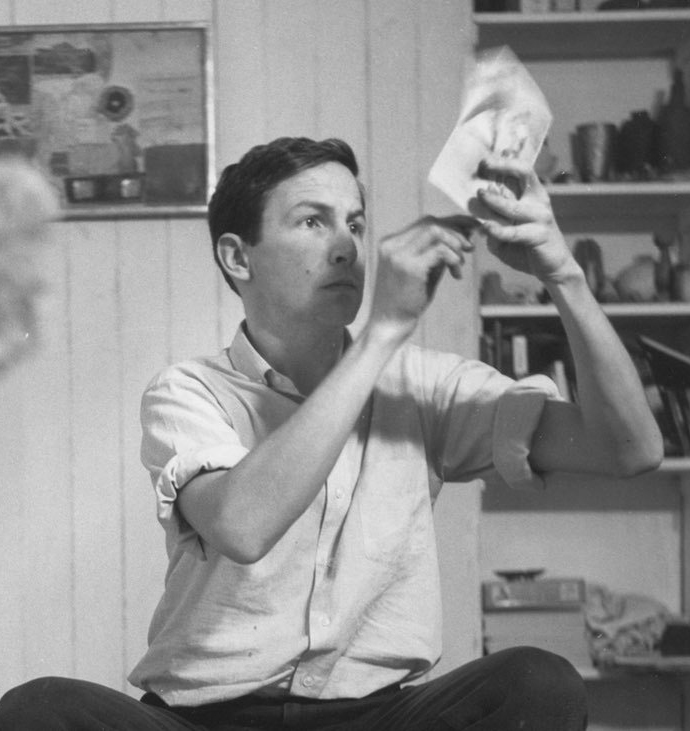
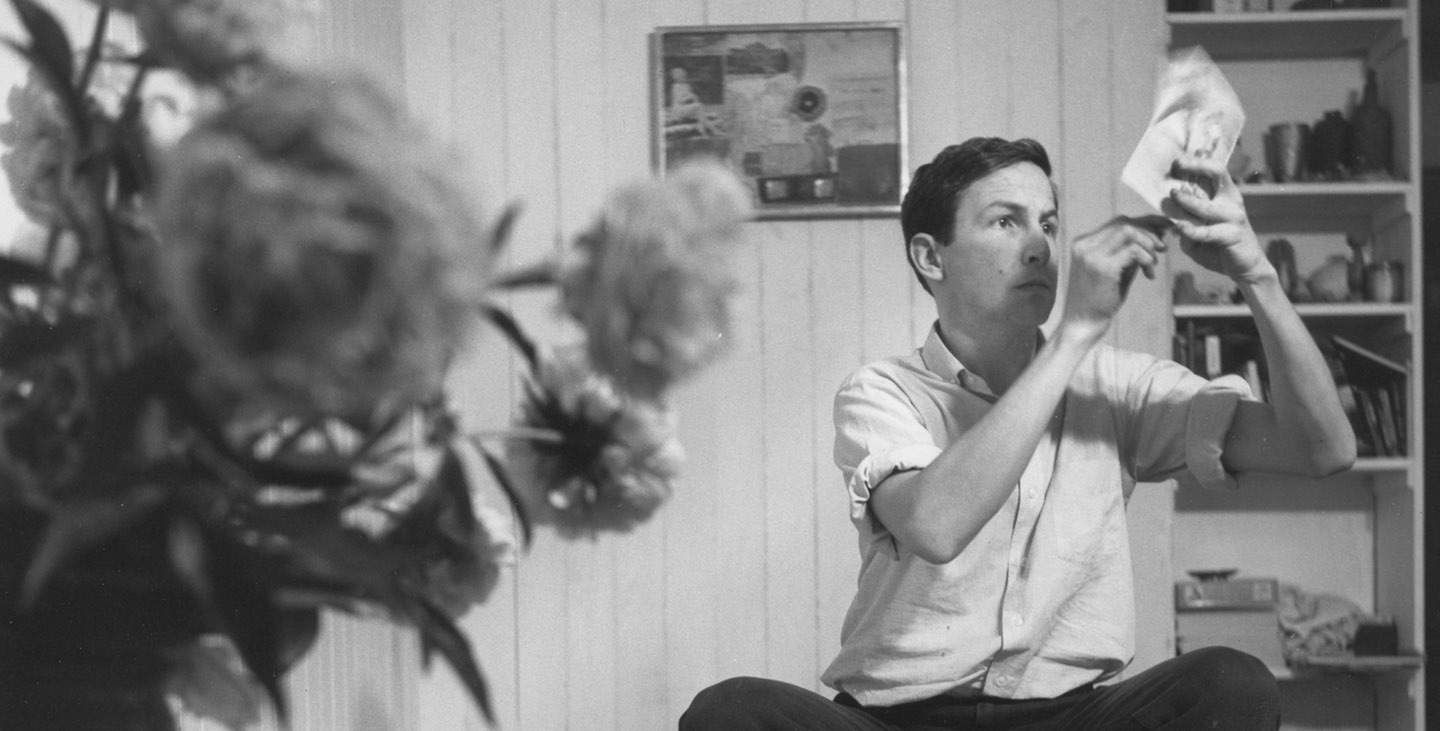
Robert Rauschenberg with "Navigator (1962)," ca. 1962.
Photo by Robert Rauschenberg © Robert Rauschenberg Foundation/VAGA. All rights reserved.
BIOGRAPHY
Early Years
Rauschenberg was born Milton Ernest Rauschenberg in Port Arthur, Texas, in 1925. He briefly attended the University of Texas at Austin to study pharmacology before being drafted into the United States Navy in 1943. He enrolled at the Kansas City Art Institute on the G.I. Bill in 1947 and at the Académie Julian in Paris the following year. From 1948 to 1952, Rauschenberg oscillated between the Art Students League in New York and the avant-garde Black Mountain College in North Carolina. At Black Mountain College, he studied under Josef Albers and befriended composer John Cage and dancer/choreographer Merce Cunningham, with whom he would later collaborate as a set and costume designer off and on for his life.
BIOGRAPHY
Vocabulary Development
Rauschenberg's artistic vocabulary—including sequences and progressions through time; grid formats; doublings, mirrorings, and reversals; contrapuntal shifts between building up and stripping away; and a sense of human scale—was established within the first four years of his career, which began in earnest in 1949. From that time forward, he has drawn from, reused, and looped back through this vocabulary, imbuing each artwork with fresh ideas. In 1951, Rauschenberg created his seminal White Paintings, seemingly blank surfaces activated only by the viewer's shadow. This initial investigation into the direct relationship between the viewer and the artwork became a consistent line of inquiry that stretched throughout the artist's entire career.
BIOGRAPHY
Combines (1954–64)
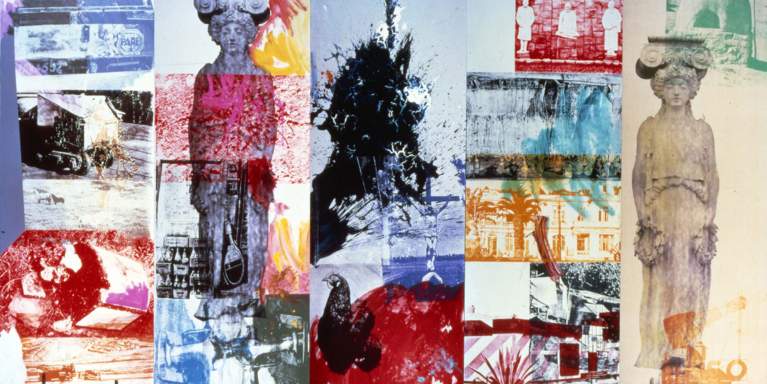
Rauschenberg's celebrated Combines (1954–64) brought real-world images and objects into the realm of abstract painting and countered the traditional divisions between painting and sculpture. These works initiated his ongoing dialogue between the handmade and the readymade, the gestural brushstroke and the mechanically reproduced image, and between mediums. Like most of the artist's work to follow, the Combines were permeated with art-historical and mass-media references, making use of reproductions from newspapers and magazines, while emphasizing autobiographical subjects and utilitarian objects. Animals, body parts, modes of transportation, fine-art reproductions, lettering, and diagrams are many of the motifs that were central to Rauschenberg's oeuvre, which was typically produced in series.
BIOGRAPHY
Return to Two Dimensions
Rauschenberg returned to two-dimensional painting in 1962 when he introduced a new body of work using transferred images culled from his own photographs and contemporary news sources via the silkscreen technique. In 1963 a major exhibition of his work was mounted at the Jewish Museum in New York and in 1964 he was awarded the Grand Prize at the Venice Biennale that established his international reputation. For the remainder of the 1960s, Rauschenberg concentrated his art practice on printmaking, performance (mostly his own choreography), and technology-based works. Rauschenberg's lifelong commitment to collaboration—with performers, printmakers, engineers, writers, artists, and artisans from around the world—is a further manifestation of his expansive artistic philosophy informed by his belief that painting relates to both art and life.
BIOGRAPHY
From New York to Captiva
With his move in 1970 from New York to Captiva (an island off the Gulf Coast of Florida), Rauschenberg cleared his palette. Retreating from urban imagery, he now favored an abstract idiom and the use of natural fibers, creating assembled works on paper, cardboard, and fabric. His lifelong quest for new materials and new ideas led him to continuously explore innovative and often untraditional avenues. In 1976, he was recognized as America's bicentennial artist with a retrospective exhibition at Washington's National Collection of Fine Arts (now the Smithsonian American Art Museum), an exhibition that traveled to four other major American cities.
BIOGRAPHY
Increasingly International References
While Rauschenberg's references became increasingly international throughout the 1970s, this engagement reached an official and consolidated manifestation when the artist founded the Rauschenberg Overseas Culture Interchange (ROCI) in 1984. An evolving exhibition of over 200 works, the project was a tangible expression of Rauschenberg's belief in the power of art and artistic collaboration to bring about social change on an international level and the culmination of his long-term commitment to human rights. From 1984 through 1991, he traveled to ten politically repressed countries. This experience incited direct cultural references in his own works during this period in which he explored the use of metal as a support for paint, tarnishes, enamel, and screenprinted images. Beginning in 1992 through to his death in 2008, Rauschenberg utilized an Iris printer to make digital color prints of his photographs, which he transferred by hand with biodegradable, vegetable dyes. The resultant high-resolution images and luminous hues of these large-scale works underscored his life-long interest in the latest advances in technology as well as echoed his concerns for the environment. Rauschenberg was honored with his third and last retrospective in 1997, a 450-work exhibition that filled three New York museums and toured internationally.
BIOGRAPHY
Further Career Development
As Rauschenberg's career developed, he took full measure of the world. He came to incorporate images—mostly his own photographs—from around the globe into his ever-expanding repertoire. Both as an artist and as a person, he knew no boundaries. In effect, Rauschenberg served as a global ambassador in much the way that Baroque artist Peter Paul Rubens did. Rauschenberg's artistic vision invariably evinced optimism, hope, and humor, while at the same time sustaining serious insight into the human condition. His social activism embraced racial equality, anti-war efforts, ecological issues, artists' rights, and human rights in general. Like Thomas Jefferson—one of America's foremost statesmen—Rauschenberg possessed an innate belief in philanthropy and a grand sense of goodwill.
BIOGRAPHY
The Robert Rauschenberg Foundation
In 1990 the Robert Rauschenberg Foundation was created in New York, which embraced a socially responsible mission in the arts, creating works for organizations involved in such issues as education and world hunger. Rauschenberg was an artist who thought, acted, and painted globally, and for over half a century, he produced a truly inventive art.